Best Cat Harness for Walking
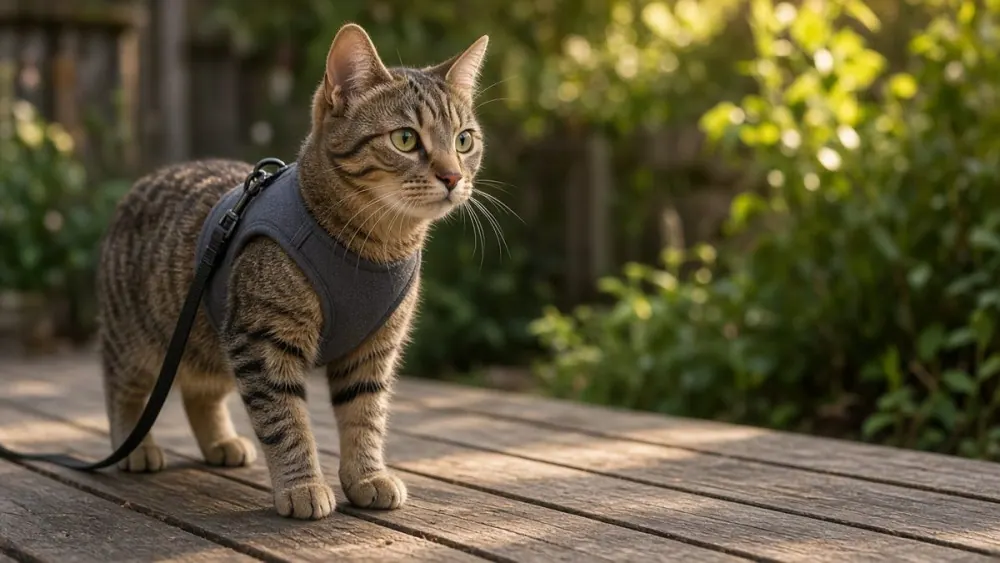
A walking harness lets an indoor cat explore a yard, a quiet sidewalk, or a balcony under your control. It is not a substitute for a cat carrier in the car or at the vet, and it is not a license to roam. No harness is truly escape-proof. A loose fit, a worn fastener, or a startled jump can still get a cat out. Always supervise, never use a harness as a tie-out, and never clip a leash to a breakaway collar.
For general feline health context, the Merck Veterinary Manual cat-owner pages are a reliable starting point, and your veterinarian should guide individual decisions.
This shortlist covers four in-stock options: a made-in-USA cotton vest that closes with hook-and-loop, a budget mesh vest that includes a leash, a slim PetSafe walking harness with a bungee lead, and a larger mesh vest for bigger cats. We are not field-testing these on the sidewalk. We are comparing current listings, published size ranges, and the honest limits each maker prints. Measure the cat’s neck and chest girth, then buy the size that matches the chart, not the age or the breed name.
As an Amazon Associate, we earn from qualifying purchases.
Quick picks
- Best easy-on vest: Kitty Holster, denim, size M/L — a soft cotton vest with an undyed lining, a metal D-ring, and wide hook-and-loop closures. This listing is M/L (neck 10–13 inches, girth 16–20 inches). It does not include a leash. The brand itself says there is no truly escape-proof cat harness.
- Best budget vest and leash set: rabbitgoo harness and 4.9-foot leash, size S, black — a mesh vest for average adult cats, sized for a 11–13.7-inch neck and an 18–20-inch chest. The listing also asks for a minimum head circumference of 11.4 inches so the cat cannot back out.
- Best slim walking harness with a bungee leash: PetSafe Come With Me Kitty, medium, royal blue — a nylon harness that applies pressure across the shoulders rather than the throat, plus a stretchy leash. This medium size is for a 10.5–14-inch girth, so many larger adults need the large size on the same page.
- Best vest for larger cats: rabbitgoo harness and leash, size M, black — the same mesh vest style, sized for a 15–19-inch neck and a 21–25-inch chest, with a 4.9-foot leash included.
Comparison table
| Product | Best for | Size we linked (listing) | Includes a leash? | Good to know |
|---|---|---|---|---|
| Kitty Holster, M/L denim | Cats that dislike overhead harnesses, and people who want a simple vest | Neck 10–13”, girth 16–20”. Other sizes run XS to XL. | No. You need a separate leash. | Cotton vest, hook-and-loop, training pamphlet, made in the USA. Do not use as a tie-out. Inspect the closures for wear. |
| rabbitgoo vest set, S | An average adult cat, if the measurements match | Neck 11–13.7”, chest 18–20”; min. head 11.4” | Yes, 4.9 ft | Over-the-head mesh vest, dual buckles, reflective strips. “Escape-proof” is marketing; a poor fit can still fail. Not chew-proof. |
| PetSafe Come With Me Kitty, M | A slimmer, non-vest harness for a smaller or average cat | Girth 10.5–14” | Yes, bungee leash | Two adjustment points; pressure is meant to sit on the shoulders. This medium size is small. Measure before you buy. |
| rabbitgoo vest set, M | Larger cats that outgrow size S | Neck 15–19”, chest 21–25” | Yes, 4.9 ft | Same style as the S set, just a bigger chart. Confirm head circumference and chest before checkout. |
Size charts differ by brand, and the same letter does not mean the same inches. A PetSafe medium is much smaller than a rabbitgoo medium. If the cat is between sizes, a slightly snug, well-adjusted fit is safer than a roomy one the cat can wriggle out of, as long as you can still slide two fingers under a strap and the cat can breathe and walk normally.
How to choose and fit a cat harness
Measure with a soft tape: the neck where a collar would sit, and the girth around the deepest part of the chest, just behind the front legs. Do this while the cat is standing, not curled in a loaf. Compare those numbers to the current chart on the listing you are about to buy.
Style is a comfort issue as much as a security issue. Vest harnesses, like the Kitty Holster and rabbitgoo, spread pressure over the chest and are often harder to back out of when they fit. Some cats hate having a vest wrapped around them, or they walk like a stiff toy until they get used to it. Slim walking harnesses, like the Come With Me Kitty, put on faster and leave more of the body free, but they have less surface area. A figure-8 or H-style harness that sits too loosely at the neck is easier to escape.
Fit test indoors. You should not be able to pull the harness forward over the shoulders, and the cat should not be able to step out of it with a shrug. If the hook-and-loop looks fuzzy or a buckle cracks, replace the harness. The Kitty Holster listing tells you to inspect closures and not to use the vest as a tie-out. Follow that advice on every harness here.
Train in short indoor sessions first. Let the cat wear the harness with the leash dragging in a closed room, then pick up the leash and follow the cat, rather than marching them like a dog. Outdoor time should stay supervised and short at first. A harness walk is enrichment for an indoor cat, not a reason to stop using a carrier for travel; see our guides to indoor cats vs outdoor cats and best cat carriers for travel.
Keep vaccinations, flea control, and ID current if the cat will go outside at all, even on a leash. A startled cat can slip a harness and be gone in seconds.
1. Best easy-on vest: Kitty Holster (denim, M/L)
The Kitty Holster M/L is a 100 percent cotton vest with a gentle undyed lining, wide hook-and-loop closures, and a metal D-ring. There are no plastic buckles to fumble. A training pamphlet comes in the package. The M/L size on this link fits a 10–13-inch neck and a 16–20-inch girth; the same design is also sold in XS, S/M, and XL. The current denim M/L was in stock when we checked. You will need a separate leash.
The listing is unusually honest: there is no true escape-proof cat harness, and you should always supervise, inspect the vest for wear, and replace it if the closures get tired or the fabric tears. Do not use it as a tie-out. That is the right way to think about every product in this guide.
This is a strong pick if you want something that goes on without being pulled over the head, or if your cat has been fussy about mesh vests. Cotton is comfortable in mild weather; it is not a substitute for checking that the vest is snug after a wash, because cotton can relax a little. If your cat is a dedicated chewer, watch the closures and do not leave the vest on unattended.
2. Best budget vest and leash set: rabbitgoo size S
The rabbitgoo size S set includes a black mesh vest and a 4.9-foot leash. The S size is listed for a 11–13.7-inch neck and an 18–20-inch chest, with a minimum head circumference of 11.4 inches. You slip it over the head, adjust four straps, and close two quick-release buckles. Reflective strips are built in, and the leash clips to a back D-ring. The current black S set was in stock when we checked.
The listing calls this harness “escape-proof.” Treat that as marketing. A vest with a correct head and chest measurement is harder to wriggle out of than a loose one, but a determined cat can still back out, especially if a buckle is not fully seated. The listing also says the harness is not chew-proof. Check the straps after each walk.
This is a practical starter set if your cat’s measurements land in the S range and you want a leash in the box. If the chest is over 20 inches, skip this link and use the size M below instead of forcing the S.
3. Best slim walking harness: PetSafe Come With Me Kitty (medium, with bungee leash)
The PetSafe Come With Me Kitty, medium is a lighter, non-vest design in royal blue, sold with a stretchy bungee leash. Two adjustment points customize the fit. The listing says the harness applies pressure to the shoulders rather than the throat when the cat hits the end of the leash, and that the bungee gives a little instead of a sharp jerk. This medium size is for a 10.5–14-inch girth. That is a small-to-average cat, not a large adult. The same product page also offers small and large; this link is the medium, which was in stock from Amazon when we checked.
Because there is less fabric, fit and adjustment matter even more. Follow the maker’s directions, acclimate indoors, and start with short, quiet walks. The “hard for her to get out of on her own” language is still not a guarantee. If your cat has a 16- or 18-inch chest, this medium is the wrong size, no matter how well the brand is known.
4. Best vest for larger cats: rabbitgoo size M
The rabbitgoo size M set is the same mesh vest and 4.9-foot leash as the S, sized for a 15–19-inch neck and a 21–25-inch chest. The current black M was in stock when we checked. Use this when the cat is simply too broad for the S chart, not because “M” sounds like a default adult size.
The same caveats apply: measure, seat the buckles, ignore “escape-proof” as a promise, and retire a chewed strap. A larger vest does not make unsupervised outdoor time safe.
How to start walking, and when not to
Keep first outdoor sessions short, close to home, and away from dogs and busy streets. Carry a carrier or a towel as a backup if the cat panics. If the cat flattens, tries to bolt, or works at the fasteners, go back inside and try a shorter indoor session later. Some cats never enjoy a leash walk; that is fine. A window perch or a play session can be enough enrichment.
Do not walk a cat that is not up to date with the preventive care your veterinarian recommends for outdoor exposure, and do not use a harness on an unhealed wound or after surgery unless your vet says so. A harness is gear, not a behavior treatment and not a way to “fix” a cat that darts out the door. For door-darting, manage the exits and get professional behavior help if needed.
FAQ
If you take one thing from this guide, let it be this: measure the cat, buy the chart that matches those inches, and treat every walk as supervised. A well-fitted vest and a short, quiet outing beat a loosely buckled “escape-proof” harness on a busy street.