Best Puppy Teething Toys
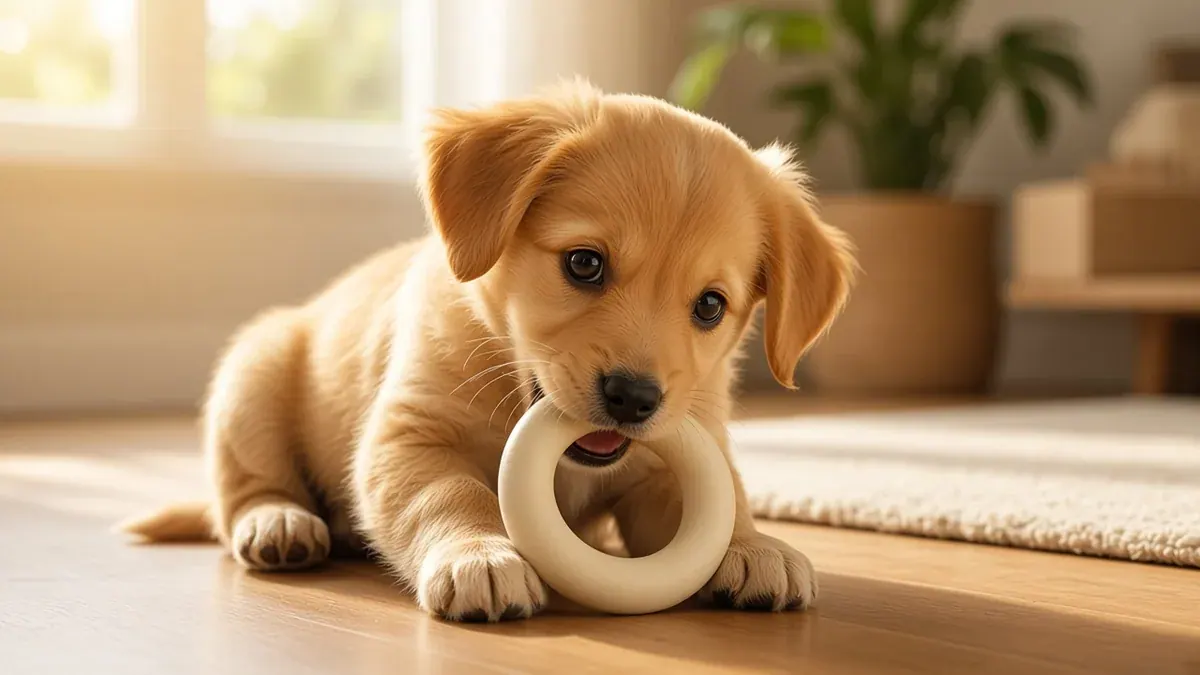
Puppy teething is messy, loud, and temporary, but it is also the window when a lot of household damage happens. Most puppies start losing baby teeth around 12 weeks of age, and most adult teeth are in by six to seven months. During that stretch, chewing is how they relieve sore gums and explore the world. The goal is not to find an “indestructible” puppy toy. It is to offer something soft enough for baby teeth, interesting enough to beat the table leg, and safe enough that you can stay in the room and take it away when it starts to break.
Several of these teething toys also work as budget-friendly stocking stuffers. We collected the compact options, with supervision notes, in our dog stocking stuffers guide.
Play and enrichment work best alongside sound training habits; the AKC expert advice on dog training is a useful overview.
This guide is a research-based shortlist of teething options that were in stock on Amazon at the time of writing: a stuffable rubber classic, a freezable textured ring, an edible teething chew, and a flexible licking cup you can stuff and chill. They are not a substitute for supervision, and they are not a lab test we ran ourselves.
As an Amazon Associate, we earn from qualifying purchases.
Quick picks
- Best overall teething toy: KONG Puppy (small linked here; size up or down by your puppy’s expected adult weight) — soft natural rubber you can stuff and freeze.
- Best freezable ring for back gums: Nylabone Puppy Chew Teething Ring (X-Small, for puppies up to 15 pounds) — a soft, textured ring, not the hard adult nylon.
- Best edible teething chew: N-Bone Puppy Teething Rings (chicken flavor, six rings) — a consumable chew, not a long-lasting toy.
- Best stuff-and-lick option: West Paw Toppl (small) — a flexible, dishwasher-safe cup that works well stuffed and chilled.
Use the thumbnail test on every chew that enters the house: press a thumbnail firmly into the surface. If it does not dent, it is probably too hard for a mouth full of baby teeth or erupting adult teeth. Skip antlers, hooves, cooked bones, ice cubes, and adult-hard nylon until your veterinarian says the adult teeth are fully in and the chew is appropriate.
Comparison of puppy teething options
| Product | Best for | What it is | Size we linked | Good to know |
|---|---|---|---|---|
| KONG Puppy | Most puppies, especially if you want one toy to stuff, freeze, and also toss | Soft natural rubber, hollow and stuffable | Small (maker chart: up to about 20 pounds; other sizes exist) | Gentler than the red KONG Classic. Plan to move up around nine months. |
| Nylabone Puppy Chew Teething Ring | Reaching the back gums; short, calming chew sessions | Soft, flavored, freezable ring | X-Small, for puppies up to 15 pounds | This is the soft puppy line, not Nylabone’s hard adult chews. Buy a larger puppy size if your pup is already over 15 pounds. |
| N-Bone Puppy Teething Rings | Puppies that prefer something they can actually eat | Edible chicken-flavored rings, sold as a six-pack | One pack of six rings | Supervise closely and treat these as snacks, not as unattended toys. |
| West Paw Toppl | Licking and slow work when gums are sore | Flexible Zogoflex cup, freezable and dishwasher safe | Small | A licking job can be gentler than hard gnawing. Size up for larger breeds. |
Prices change, and colors or sizes can go in and out of stock. Check the current listing, including the size, before you buy.
1. Best overall: KONG Puppy
Who it’s for: Almost any teething puppy that can be taught to chew a rubber toy, including puppies that need a job in the crate. The small size linked here is a common starting point. KONG also makes extra-small, medium, and large Puppy toys, sized by expected adult weight rather than age: extra-small up to about 5 pounds, small up to about 20, medium about 15 to 35, and large about 30 to 65. If you are between sizes, or your puppy is already a strong chewer, size up.
The reason this toy shows up in so many teething guides is the rubber, not the brand name. KONG Puppy uses a softer natural rubber than the red KONG Classic, which is the point: baby teeth and brand-new adult teeth should not be working on a toy you cannot indent with a thumbnail. The hollow snowman shape can be smeared with a little puppy-safe wet food or plain yogurt, or packed loosely with kibble and a dab of xylitol-free peanut butter, then frozen. A cold, stuffed KONG turns a three-minute chew into a longer licking session, which is often kinder on sore gums than frantic gnawing. The uneven bounce also makes it useful for a short indoor fetch on days when the puppy has energy and a tender mouth at the same time.
Trade-offs: Soft rubber wears faster than adult rubber, and a determined four-month-old can thin the wall. Inspect it every time and throw it away when the rubber is punctured or pieces can come off. KONG does not recommend the Puppy line for dogs older than about nine months; most puppies should then move to a size-appropriate adult dog toy, often the KONG Classic, not the hardest “extreme” chew on the shelf.
How to use it: Stay in the room and start with an easy filling so the puppy wins quickly. If you freeze it, let the outside warm for a minute so the tongue does not stick to icy rubber. Skip fillings with xylitol, raisins, onions, or rich leftovers.
Check the current price of the KONG Puppy on Amazon
2. Best freezable ring: Nylabone Puppy Chew Teething Ring (X-Small)
Who it’s for: Smaller puppies, up to about 15 pounds, that like to hold a ring and worry the back of the mouth. This X-Small chicken-flavored ring is a different shape from a stuffed rubber toy, and that is why it is on the list. A ring can sit between the rear gums, which is often where premolars are pushing through during the peak teething weeks.
This chew is made from a softer puppy material, and the listing is explicit: it is not intended for powerful chewers or for puppies that already have their adult teeth. That warning matters, because the same shelf holds Nylabone’s much harder adult nylon chews and a firmer “Puppy Power Chew” line. Read the label and buy the soft Puppy Chew, not a hard nylon bone. If your puppy is already over 15 pounds, choose a larger size in the same soft puppy line.
The surface has ridges and nubs, and the toy can go in the freezer. A slightly chilled ring often feels better on inflamed gums than a room-temperature one. Do not freeze it into a solid block; you want cool, not concrete. Replace it when the nubs are worn flat or any piece could be swallowed. This is a short-session chew, not an all-afternoon babysitter.
Check the current price of the Nylabone Puppy Teething Ring on Amazon
3. Best edible option: N-Bone Puppy Teething Rings
Who it’s for: Puppies that lose interest in rubber and want something they can actually eat, or owners who want a teething chew they can hand over during a short, watched session. This chicken-flavored six-pack is a chew treat, not a rubber toy. The rings are pliable compared with hard baked chews, and they are sold as a teething aid with added calcium.
Edible teething rings fill a real gap, but they change the safety rules. You are no longer only watching for a toy to break. You are also watching how fast your puppy eats it, whether large chunks are being swallowed, and how the chew fits into the day’s calories. Give one ring at a time, on a mat or in your lap, and take it away when it is small enough to gulp. These are not crate chews to leave behind when you leave the house.
Trade-offs: A six-pack does not last long with a busy chewer, and some puppies try to swallow pieces that are still too big. If your puppy is a gulper, skip edible rings and go back to a stuffed rubber toy. If the stomach is sensitive, introduce any new chew the way you would a new treat: a small amount, then wait and see.
Check the current price of N-Bone Puppy Teething Rings on Amazon
4. Best licking option: West Paw Toppl (Small)
Who it’s for: Puppies that frantically chew when their mouth hurts and might do better with licking, and owners who want a washable, stuffable cup they can freeze. The small Toppl linked here is a flexible Zogoflex cup made in the USA. It has an open top and interior ridges, so you can smear wet food or a thin layer of xylitol-free peanut butter, or wedge a few pieces of kibble, then chill it.
Licking is underrated during teething. It is repetitive, it does not require the same bite force as gnawing on a bone, and it can occupy a puppy during a quiet hour. The Toppl is dishwasher safe, which matters once you have packed it with wet food. The material is designed to flex; you should still be able to indent it with a thumbnail. Two Toppls of different sizes can be pressed together into a harder puzzle later, but a teething eight-week-old only needs one open cup.
Trade-offs: The small size will be too small for a large-breed puppy. Size up if your puppy can fit the whole cup in its mouth or chew the rim aggressively. It is not a fetch toy in the same way a KONG is, and it costs more than a basic ring. What you are paying for is a washable licking toy you can keep after teething ends, including as part of interactive feeding and enrichment.
Check the current price of the West Paw Toppl on Amazon
How to tell if a teething toy is safe
The thumbnail test is the most useful rule in this article. Press your thumbnail firmly into the toy. If the surface does not give, put it back. Hard chews, including many adult nylon bones, antlers, hooves, and cooked bones, are a common way puppies fracture baby teeth or brand-new adult teeth. Ice cubes have the same problem: cold can feel good, but solid ice is hard. If you want cold, chill a soft rubber toy or a wet washcloth that you have knotted and wrung out, and stay with the puppy so the cloth is not shredded and swallowed.
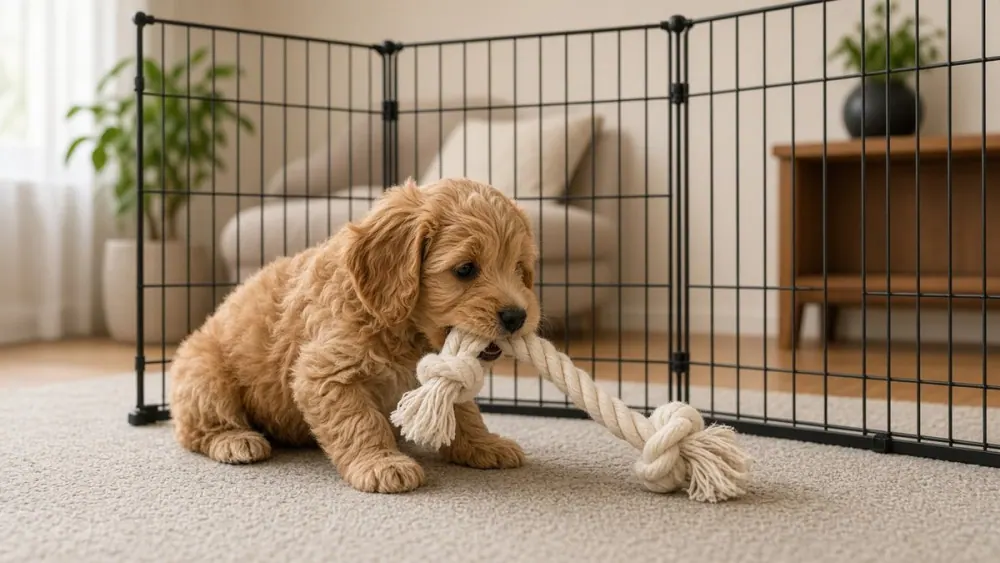
Other practical rules: stay in the room and take the toy away as soon as it is damaged or small enough to swallow. A toy that can fit all the way behind the tongue is too small. Skip human teething gels unless your veterinarian has prescribed something; some human products are dangerous for dogs. Watch the ingredients in fillings and edible chews. Xylitol (sometimes listed as birch sugar) is toxic to dogs, as are grapes, raisins, onions, and many sugar-free peanut butters. Cotton rope toys can fray, so inspect them constantly and throw them out at the first sign of shredding. Hard “indestructible” toys can wait. Our guide to tough toys for power chewers is for adult dogs with adult teeth, and even then no toy is truly indestructible.
A simple teething routine that actually helps
Rotate two or three options rather than dumping a basket of toys on the floor. A stuffed, frozen KONG or Toppl in the morning, a short session with a chilled ring later, and a walk or training game in between will usually do more than a pile of cheap plastic. If you are crate training, a stuffed toy can make the crate a place where good things happen, but only if you can still check the toy often.
Keep the fillings boring and puppy-safe: part of your puppy’s regular kibble, a spoonful of the wet food you already feed, plain pumpkin, or a thin smear of xylitol-free peanut butter. If you are choosing a puppy food, use that same food in the toy so you are not adding a new diet on top of teething stress. Replace toys the moment they fail. A split KONG, a ring with a broken knob, or an edible chew worn down to a swallowable stub is a choking hazard, not a teething aid.
Frequently asked questions
A teething puppy also needs a safe place to rest between chewing sessions. Our dog crates guide covers sizing and divider panels for a growing puppy.
For a roomier, short-term play area, our dog playpens guide compares metal exercise pens and how tall they need to be.
If you take one thing from this list, let it be this: choose a toy soft enough to dent with your thumbnail, size it so it cannot be swallowed, and stay in the room. The right teething toy is the one you can inspect, freeze if needed, and throw away the day it fails.